28/10/2021
This year again, dinar and FX savings are at their new record highs ahead of the World Savings Day (31 October). The continuous rise indicates that citizens have confidence in the local financial system and the national currency, as a result of monetary and financial stability that has been maintained for a number of years now. In such conditions, dinar savings have been growing at a faster pace than those in FX for the ninth year in a row, and this year they shot past RSD 100 bn for the first time ever.
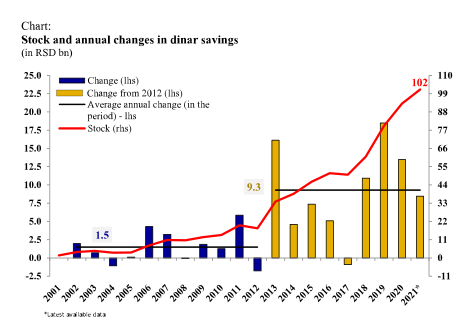
At end-September 2021 dinar savings reached RSD 101.5 bn, having risen in the past nine years (from end-2012) by almost six times or by as much as RSD 83 bn. More than a half of the total rise was recorded in the past three years (around RSD 45 bn relative to end-September 2018). Since 2013, savings on average gained over RSD 9 bn per year, which is six times more than in the period before 2012 (RSD 1.5 bn). In the last year alone (from October 2020), saving in the local currency went up by around 14%.
FX savings also recorded growth in the same period, though somewhat more moderate compared to dinar savings. Namely, FX savings increased from EUR 8.3 bn at end-2012 to EUR 12.3 bn at end-September 2021.
The rise in savings is a result of the improvement of Serbia’s overall macroeconomic position in the prior period, underpinned by a responsible economic policy conduct. The value of the dinar against the euro has been preserved, FX reserves are at the record high of EUR 16.8 bn (end-September) and the share of NPLs has been cut to 3.5% (end-August). To the current inflationary pressures, which are for their major part of global character, the NBS responded promptly and adequately by tightening monetary conditions, and will continue, if necessary, to react timely with all instruments on hand in order to maintain monetary stability.
Strong macroeconomic results were also affirmed in the international market, where Serbia successfully issued government securities (7Y green eurobond worth EUR 1.0 bn and 15Y eurobond worth EUR 750.0 mn) at the lowest rates of financing thus far.
Ahead of the World Savings Day, the NBS prepared the analysis of the profitability of savings for the period September 2012 – September 2021, which has confirmed once again that it pays off more to save in dinars.
Higher profitability of dinar savings is underpinned by years of macroeconomic, financial and fiscal stability, relatively higher interest rates on dinar than on euro savings, more favourable tax treatment of dinar savings, and the well-timed monetary and fiscal measures implemented to mitigate the negative effects of the pandemic-induced crisis.
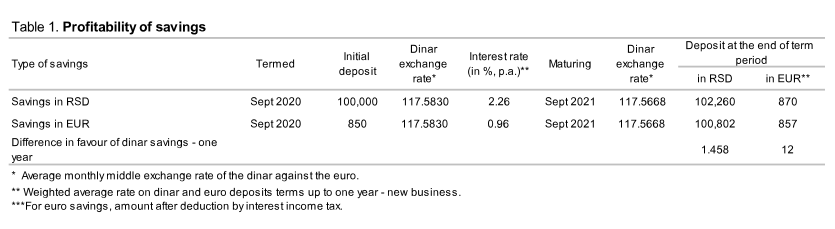
In the past nine years, one-year dinar savings (without rollover) were more profitable in as much as 98% of the observed one-year subperiods. Thus, a person who deposited RSD 100,000 in September 2020 would receive around RSD 1,500 (or EUR 12) more compared to a person depositing the euro equivalent (Table).
The results of the analysis show that in case of three-month deposits, dinar savings are more profitable than euro savings in more than 87% of the observed three-month sub-periods, while in case of deposits termed for two years, dinar savings are more profitable in all of the observed two-year sub-periods.
In other words, in the past nine years it was more profitable to save in dinars than in FX both in the short and long run.
The NBS remains committed to encouraging the process of dinarisation in the period ahead, and hence to promoting dinar savings and emphasizing their greater profitability.
Governor’s Office