12/08/2021
Continuing their growth amid the pandemic of an unprecedented scale, dinar savings exceeded RSD 100 bn in July. Unhindered continuous growth of both dinar and FX savings was recorded thanks to the preserved macroeconomic stability. This was supported by timely measures of monetary and fiscal policies aimed at mitigating the negative effects of the crisis on households and the economy as a whole. Citizens’ trust in the domestic currency resulted in faster growth of dinar relative to FX savings, for the ninth year in a row.
Over the past nine years, dinar savings rose almost six times (by as much as RSD 81 bn), reaching RSD 99 bn in mid-2021. Particularly robust growth was recorded in the last three years which saw a rise of over RSD 45 bn, almost one half of total growth in dinar savings.
In the same period FX savings also rose, though somewhat more moderately compared to dinar savings – from EUR 8 bn (RSD 911 bn) at end-June 2012 to EUR 12 bn (RSD 1,425 bn) at end-June 2021.
Despite the prolonged health crisis, an adequate response in the form of package of economic measures, which the NBS and Serbian Government adopted in coordination, helped Serbia to reach the pre-crisis level of economic activity already in the first quarter of this year. At the same time, monetary and financial stability has been preserved, which is a precondition for the strengthening of confidence in the domestic financial system and the local currency. This is confirmed by low and stable inflation, which in H1 this year measured 2.3% on average, the preserved value of the dinar against the euro, FX reserves at a high level of EUR 14 bn at end-June and the reduced share of NPLs measuring 3.7% at end-May.
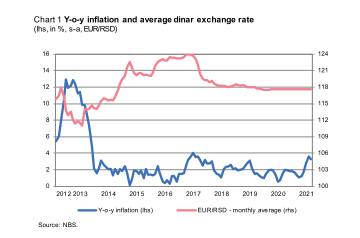
Sound macroeconomic performances of Serbia were also confirmed by the Moody’s rating agency, which upgraded Serbia’s credit rating from Ba3 to Ba2, quoting exactly these arguments – low and stable inflation, relative stability of the exchange rate, reduced external imbalances and full coverage of the current account deficit by FDI inflow.
The results of the regular semi-annual analysis of savings profitability, for the period from June 2012 until June 2021 demonstrate that it is more profitable to save in the domestic currency, thanks to the following factors:
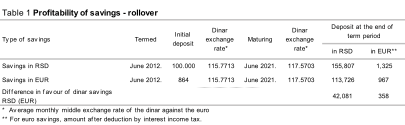
The analysis of profitability of savings termed for one year, with rollover during nine years confirmed that the depositor who saved in dinars, placing a RSD 100,000 deposit, would receive, at the end of the savings term in June 2021, over RSD 42,000 (EUR 358) more than the depositor who deposited the equivalent amount in euros during the same period (Table 1).
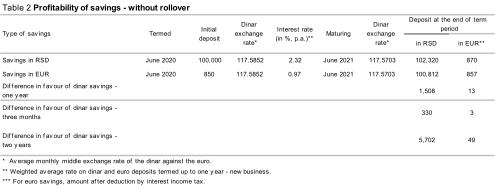
Term deposits in dinars for a one-year period (without rollover) were more profitable in the last nine years in as many as 98% annual subperiods observed. A person depositing RSD 100,000 in June 2020 would receive around RSD 1,500 (EUR 13) more in June 2021 compared to a depositor placing RSD 100,000 in the euro equivalent in the same period. (Table 2).
Governor’s Office