14/02/2025
At end-2024, dinar household savings reached their highest level of RSD 191.2 bn. Despite the prevailing global uncertainties, they continued up in H2 2024 (by RSD 30.1 bn, or 18.7%) amid favourable macroeconomic conditions – notably financial stability and the stability of the dinar exchange rate against the euro. During 2024, dinar savings posted record-high annual growth of RSD 53.3 bn, up by 38.6%.
Over the past twelve years, dinar savings have been more profitable than FX savings – both in the short and long term, as confirmed by the latest semi-annual analysis of the profitability of dinar and FX savings, for the period from December 2012 to December 2024.
Greater profitability of dinar compared to euro savings was underpinned not only by higher interest rates on dinar than on euro savings and the tax-free status of interest on dinar savings, whilst interest on FX savings is subject to 15% tax, but also by the achieved and preserved macroeconomic and financial stability in the prior years, particularly in the global crisis environment, when well-calibrated and timely monetary and fiscal policy measures played the key role.
Dinar savings increased almost elevenfold over the past twelve years. The faster growth in dinar compared to FX savings led to an increase in their share in total savings, from 1.87% in December 2012 to 9.60% in December 2024. The structure of dinar savings in H2 2024 shows that the most pronounced growth was seen for six- to 12-month deposits (RSD 22.5 bn), which were the most dominant type of savings (53.7%). A more moderate increase was recorded for three- to six-month deposits (RSD 8.6 bn) and demand deposits (RSD 6.3 bn), while savings with one- to two-year maturity decreased (by RSD 9.1 bn – partly due to the effect of the leap 2024 year). The average amount of dinar savings per lot was RSD 192,000 at end-2024.
Similarly, over the past twelve years, FX savings almost doubled, from EUR 8.3 bn in December 2012 to EUR 15.4 bn in December 2024. The growth in FX savings in H2 2024 amounted to EUR 416.5 mn, or 2.78%, largely owing to more intensive placing of six to 12-month FX deposits (EUR 582.1 mn). Growth was also recorded for three to six-month deposits (EUR 338.0 mn) and demand deposits (EUR 278.1 mn), while, on the other hand, FX savings termed one to two years declined (EUR 709.4 mn – partly due to the effect of the leap 2024 year, as was the case with dinar savings), as did two- to five-year savings (EUR 116.0 mn). The average amount of FX savings per lot was EUR 3,605 at end-2024.
Monetary policy measures adopted in recent years have been effective and appropriate, helping inflation strike a downward trajectory. Inflation has been slowing since April 2023, to 4.3% y-o-y in December 2024, down by 12 pp from its peak level recorded in March 2023. As a result, inflation has remained within the NBS target tolerance band (3±1.5%) for the eighth consecutive month.
The stability of the exchange rate of the dinar against the euro was maintained in 2024 against the background of prevailing appreciation pressures. The NBS intervened in the FX market by buying EUR 2.7 bn net, propelling FX reserves to their highest end-of-month level at end-December (EUR 29.3 bn). That level of FX reserves covered more than seven months of the country’s imports of goods and services, i.e. much more than envisaged by the relevant international standards.
The share of NPLs in total loans was cut considerably since the start of implementation of the NPL Resolution Strategy, to 2.7% in November 2024.
Finally, as proof of the effectiveness of all the measures taken so far, Standard & Poor’s increased Serbia’s credit rating in early October 2024 to BBB-, placing Serbia for the first time ever among investment-grade countries. The most important factors contributing to this decision include real GDP growth relative to pre-pandemic levels, significantly increased FX reserves, a declining share of public debt in GDP, as well as responsible monetary and fiscal policies.
The analysis of profitability of savings termed for one year, with rollover during 12 years (since December 2012), confirmed that a depositor who saved in dinars, placing an RSD 100,000 deposit, would receive, at the end of the savings term in December 2024, almost RSD 48,000 (EUR 400) more than a depositor who deposited the equivalent amount in euros during the same period (calculated using the average RSD/EUR exchange rate in the month of depositing) (Table 1).
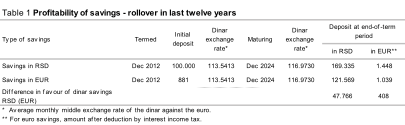
Dinar savings termed for one year without rollover proved to be more profitable than savings of the same maturity in euros in almost all of the observed annual subperiods (over 98%).
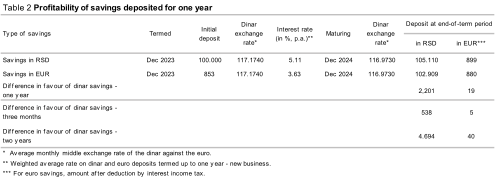
A person who deposited RSD 100,000 in December 2023 would receive almost RSD 2,200 more in December 2024 compared to a depositor placing RSD 100,000 in the euro equivalent in the same period (Table 2).
Dinar savings termed for three months were more profitable than euro savings of the same maturity in over 90% of the observed three-month subperiods, while dinar savings termed for two years were more lucrative than euro savings in all the observed two-year subperiods.
In other words, the analyses show that in the past 12 years it was more lucrative to save in dinars in both short and long run.
As advancing the process of dinarisation of the domestic financial system remains one of its important goals, in the coming period the NBS will continue to analyse the profitability of savings, as well as support and stimulate saving in the national currency.
Monetary and FX Operations Department