15/08/2025
Household savings continued to grow in 2025 despite ongoing uncertainties, reaching new record highs. In H1 2025, savings in dinars increased by RSD 4.5 bn (2.4%), amounting to RSD 195.7 bn by the end of June. FX savings also grew — by EUR 313.0 mn or 2.0%. By the end of July, dinar savings exceeded RSD 200.0 bn, while FX savings settled at nearly EUR 16.0 bn, posting the highest levels on record. Dinar savings approached a 10.0% share of total savings in domestic banks, which is significant given that this share was below 2.0% by the end of 2012.
Over the past thirteen years, dinar savings have been more profitable than FX savings – both in the short and long term, as confirmed by the latest semi-annual analysis of the profitability of dinar and FX savings, for the period from June 2012 to June 2025.
Greater profitability of dinar compared to euro savings is underpinned not only by higher interest rates on dinar than on euro savings and a more favourable tax treatment of income from interest on dinar savings, but also by the preserved stability of the financial system and relative stability of the dinar exchange rate against the euro.
Savings in the local currency have increased more than elevenfold over the past thirteen years. The faster growth of dinar savings compared to FX has led to an increase in their share of total savings — from 1.89% in June 2012 to 9.61% in June 2025. As regards the structure of dinar savings in H1 2025, there was an increase in savings with a maturity of up to six months, while savings with maturities longer than six months decreased. The most significant growth was seen in deposits with maturities from three to six months (RSD 6.3 bn). Savings with maturities from six to twelve months recorded a moderate decline (RSD 1.0 bn), but still remained the most prevalent in total savings (51.9%). The average amount of dinar savings per account at the end of June 2025 was RSD 191,000.
Over the same thirteen-year period, FX savings increased by EUR 7.8 bn, nearly doubling in size. Looking at H1 2025, the growth in FX savings was primarily driven by a significant increase in term deposits from funds previously held in demand deposits (EUR 346.8 mn), which make up 66.5% of total savings, as well as deposits with a maturity of six to twelve months (EUR 223.3 mn). The average amount of FX savings per account at the end of June 2025 was EUR 4,063.40.
In the first six months of the year, average inflation amounted to 4.3% (NBS target: 3±1.5%), while core inflation (CPI excluding food, energy, alcohol and cigarettes) declined from 5.3% in December 2024 to 4.7% in June 2025.
The relative stability of the dinar exchange rate against the euro has been maintained, despite depreciation pressures that prevailed during the first five months of the year when the NBS sold EUR 1.0 bn net in the IFEM (selling EUR 1,350 mn and buying EUR 350 mn). However, as of June, appreciation pressures gathered steam, which is why in June and July the NBS intervened in the IFEM by purchasing EUR 1,130 mn. This not only offset the earlier net foreign currency sales but also further increased the country’s FX reserves. Gross FX reserves equalled EUR 28.3 bn (EUR 24.1 bn, net) at end-July, covering almost seven months of the country’s imports of goods and services, which is significantly more than the minimum prescribed by the relevant international standards.
The share of NPLs in total loans was cut considerably since the start of implementation of the NPL Resolution Strategy in August 2015 – from 22.4% to 2.3% in June 2025.
The proactive measures taken so far and Serbia's favourable medium-term economic outlook have been confirmed by Fitch, which in July maintained Serbia’s credit rating at “BB+” with a positive outlook for achieving investment-grade status.
The analysis of profitability of savings termed for one year, with rollover during thirteen years (since June 2012), confirmed that a depositor who saved in dinars, placing a RSD 100,000 deposit, would receive, at the end of the savings term in June 2025, almost RSD 58,000 (close to EUR 500) more than a depositor who deposited the equivalent amount in euros during the same period (calculated using the average RSD/EUR exchange rate in the month of depositing) (Table 1).
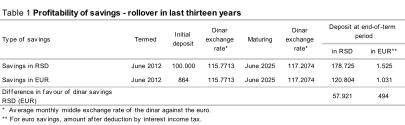
Dinar savings termed for one year without rollover proved to be more profitable than savings of the same maturity in euros in almost 99% of the observed annual subperiods (143 out of 145).
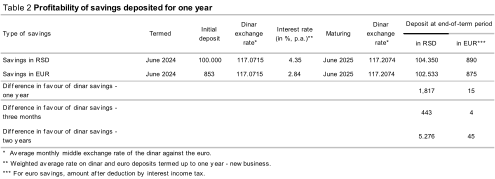
A person who deposited RSD 100,000 in June 2024 would receive over RSD 1,800 more in June 2025 compared to a depositor placing RSD 100,000 in the euro equivalent in the same period (Table 2).
Dinar savings termed for three months turned out more profitable than euro savings of the same maturity in almost 92% of the observed three-month subperiods, while dinar savings termed for two years were more lucrative than euro savings in all the observed two-year subperiods.
In other words, the analyses show that in the past thirteen years it was more lucrative to save in dinars in both short and long run.
In accordance with the strategy of dinarisation of the financial system, the NBS will continue to promote savings in domestic currency, pointing to their greater profitability.
Monetary and FX Operations Department