
The NBS Head Office Building was built from 1888 – 1890, on the basis of blueprints designed by Konstantin Jovanovic (Vienna 1849 – Zurich 1923), son to distinguished artist Anastas Jovanovic...
05/03/2026
The use of digital banking in Serbia continued to grow strongly for yet another year, reflecting the continuous improvement of banking services and user experience, alongside the expansion of payment and financial products available to citizens and businesses every day on a 24/7 basis. In addition, 2025 saw a significant turning point: for the first time since digital banking instruments were introduced to the Serbian market, the number of payments executed via mobile banking (m-banking) exceeded the number of payments carried out through electronic banking (e-banking). This trend continues to be supported by the instant payment infrastructure (the NBS IPS payment system), ensuring fast, secure and always-available payments.
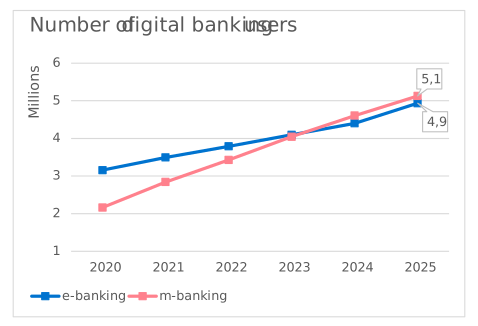
At the end of 2025, there were 5.1 million users of m-banking services, or 11.3% more than at the end of 2024 (4.6 million). As for e-banking, 4.9 million users were registered for this service at the end of 2025, representing a 12.1% increase compared to the end of 2024 (4.4 million). In addition, looking at the medium term – the past five years, the number of m-banking users has increased 2.4 times, while the number of e-banking users has grown 1.6 times.
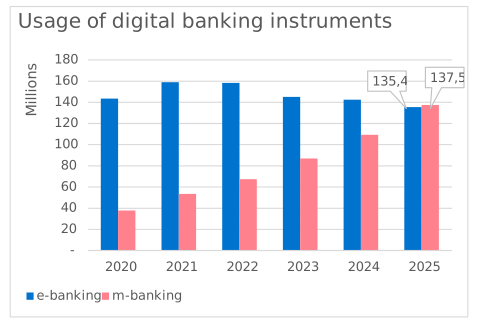
In 2025, a total of 272.9 million payments were executed by citizens and businesses using digital banking instruments. Of this number, 137.5 million payments were carried out through m-banking, which is 3.6 times more than in 2020 (37.8 million). By comparison, 135.4 million payments were executed via e-banking in 2025, representing a 5.6% decrease compared to 2020, when 143.4 million payments were recorded using this instrument.
The aforementioned contribution of the NBS IPS payment system to the increased use of m-banking refers to the wide range of possibilities for executing everyday instant payments. In addition to transferring money by entering a transfer order, this also includes making purchases at points of sale using simple and reliable payment methods – IPS Scan and IPS Show, paying bills/invoices by scanning the NBS IPS QR code, as well as sending money from account to account through the Transfer (Prenesi) service, i.e. by using a mobile phone number.
During 2025, more than 30.2 million bills and invoices for citizens’ regular monthly and other obligations were paid by scanning the NBS IPS QR code, representing a 45.2% increase relative to 2024. At the same time, for yet another consecutive year, m-banking users used the Transfer service twice as much as in the previous year to transfer money between users’ accounts, making it an increasingly common way of sending money.
A graphic overview of data on the provision of payment services and the issuance of e-money in 2024–2025 is available on the NBS website | Statistics.
Payment System Department