10.03.2025.
The use of digital banking instruments in Serbia continues its perennial growth trend, with the largest contribution to the increase in payments coming from mobile banking. The growth in recent years is linked to the long-term development of digital banking services and the offering of an increasing number of payment and financial services that are available to users on a daily basis, which is especially useful during periods when bank branch working hours have ended. An important role in the greater acceptance and use of mobile banking has been played by the launch of the new-generation payment system – the NBS IPS system for executing instant payments, which has been available to users 24/7/365 since October 2018.
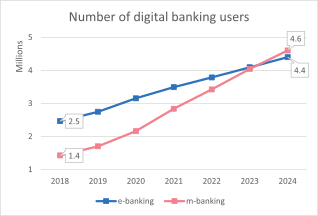
At end-2024, the mobile banking service was contracted by 4.6 million users, representing an increase of 13.9% from end-2023, when 4 million users were registered. This is also a 222.7% (3.2 times) increase compared to end-2018, when 1.4 million users were registered. As for electronic banking, at end-2024, there were 4.4 million registered users, or 7.5% more than at end-2023 (4.1 million) and 78.5% more than at end-2018 (2.5 million).
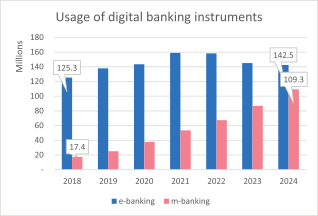
In addition to the number of users, the number of payments made through digital banking instruments also went up. In 2024, mobile banking saw the highest number of payments to date – 109.3 million payments, which is 25.7% more than in 2023 and 526.8% (6.3 times) more than in 2018. On the other hand, the number of e-banking payments stabilised in recent years, with 142.5 million payments made in 2024, 1.8% fewer than in 2023, but 13.8% more than in 2018.
The contribution of the NBS IPS payment system to the increased use of mobile banking entails broad possibilities for executing everyday instant payments. This includes not only money transfers by filling out transfer orders but also making purchases at points of sale through simple and reliable payment methods – IPS scan and IPS show, paying bills/invoices by scanning the NBS IPS QR code, as well as transferring money from one account to another via the Transfer service, i.e. using a mobile phone number.
In 2024, more than 20.8 million bills and invoices for regular monthly and other obligations of citizens, initiated by scanning the NBS IPS QR code, were paid. This represents a 42.5% increase on 2023, when 14.6 million bills were settled in this way. Also noteworthy is the increased interest in fast and easy money transfers using a mobile phone number, i.e. the Transfer service. The rise in the number of its users continued in 2024, resulting in over one million registered users at year end, which is three times more than at end-2023. In 2024, both the number and value of transfers made via mobile phone doubled compared to 2023, and the Transfer service has become an increasingly popular way to send money between mobile banking users.
A graphic overview of data on the provision of payment services and e-money issuance in the period 2023–2024 is available at: NBS | Statistics.
Payment System Department