
23.08.2024.
Vibrant growth in dinar savings attests to their greater profitability
Dinar savings continued up at brisk pace in the first seven months of 2024. Solid macroeconomic indicators, reflected primarily in preserved financial stability and relative stability of the dinar exchange rate against the euro, resulted in an RSD 27.7 bn (20.1%) increase in dinar household savings in the year so far. According to the latest operational data, in the past year, dinar savings expanded by RSD 53.6 bn (48%), reaching a record high level of RSD 165.6 bn.
The new semi-annual analysis of the profitability of dinar and FX savings for the period of twelve years, from June 2012 until June 2024, showed that it was more profitable to save in dinars both in the short and long run.
Greater profitability of dinar compared to FX savings was underpinned not only by higher interest rates on dinar than on euro savings and the tax-free status of interest on dinars savings, whilst interest on FX savings is subject to 15% tax, but also by achieved and preserved macroeconomic and financial stability in the prior years, particularly in the multi-year crisis environment, when well-calibrated and timely monetary and fiscal policy measures played the key role.
Local currency savings rose more than ninefold in the past twelve years. Positive changes were also seen in the composition of dinar savings, i.e. long-term deposits rose from RSD 2.0 bn in June 2012 to RSD 36.6 bn in June 2024. As dinar savings rose faster than FX savings, their share in total savings increased from 1.89% in June 2012 to 8.41% in June 2024. In H1 2024, the growth was the most pronounced for six- to 12-month deposits (RSD 19.4 bn), which were the most dominant type of saving (making up almost a half of dinar savings). A somewhat more moderate increase was noted for demand savings (RSD 6.2 bn) and over two-year savings (RSD 1.0 bn), while savings with one-to two-year maturity declined (RSD 4.2 bn – partly due to the effect of the leap 2024 year). The average amount of dinar savings per lot equalled RSD 165,000.0 at end-June.
In the past twelve years, FX savings almost doubled, from EUR 7.9 bn in June 2012 to EUR 15.0 bn in June 2024. In H1 2024, FX savings increased by EUR 557.8 mn or 3.87%, largely owing to more intensive placing of six to 12-month FX deposits (EUR 698.9 mn). A more moderate rise was also recorded for demand savings (EUR 196.3 mn). FX savings termed one to two years declined (EUR 218.4 mn – partly due to the effect of the leap 2024 year). The average amount of FX savings per lot equalled EUR 3,162 at end-June.
Monetary and fiscal policy measures adopted in the past years helped inflation strike a downward trajectory. In July, y-o-y inflation measured 4.3%, moving within the target tolerance band (3±1.5%) for the third month in a row.
Relative stability of the exchange rate of the dinar against the euro has been maintained in 2024 as well, amid prevailing appreciation pressures. In the year so far, the NBS intervened by buying EUR 1.8 bn net, boosting FX reserves to over EUR 28 bn. Such level of FX reserves covers over 7.4 months’ worth of goods and services imports, which is much above the minimum envisaged by international standards.
Standard & Poor’s (in April) and Fitch (in early August) upgraded Serbia’s outlook from stable to positive, affirming the credit rating at BB+.
Foreign investors’ confidence in Serbia’s sound and sustainable economic indicators and credit rating was also confirmed by our country’s successful, first issue of ten-year dollar sustainability eurobonds in the international capital market in June (the proceeds will be used for sustainable, green agenda and social responsibility projects). Securities worth USD 1.5 bn were sold, with total investor demand exceeding USD 6.5 bn. The issue was followed by a hedging transaction, with liabilities converted into euros. Financing costs were thus further reduced and the post-hedging rate equalled 4.75%.
In late June, the IMF made the decision on the successful completion of the third review of Serbia’s economic programme, supported by the stand-by arrangement. Owing to the good results achieved, the arrangement will be further treated as a precautionary arrangement (funds will not be used unless in case of balance of payments needs).
Greater profitability of dinar compared to FX savings
The analysis of profitability of savings termed for one year, with rollover during 12 years (since June 2012), confirmed that a depositor who saved in dinars, placing an RSD 100,000 deposit, would receive, at the end of the savings term in June 2024, almost RSD 53,500 (EUR 460) more than a depositor who deposited the equivalent amount in euros during the same period (calculated using the average RSD/EUR exchange rate in the month of depositing) (Table 1).
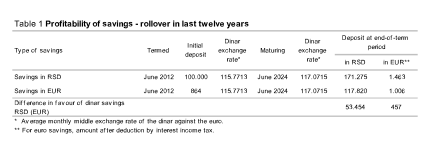
Dinar savings with one-year maturity were more profitable than savings in euros in almost all observed annual subperiods (over 98%).
A person who deposited RSD 100,000 in June 2023 would receive almost RSD 2,900 more in June 2024 compared to a depositor placing RSD 100,000 in the euro equivalent in the same period (Table 2).
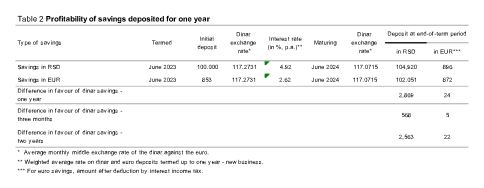
Dinar savings with three-month maturity were more profitable than savings in euros in most observed quarterly subperiods (over 90%), and dinar savings with two-year maturity were more profitable than savings in euros in all observed two-year subperiods (100%). As shown by analyses, in the observed twelve-year period, it was more profitable to save in dinars, regardless of the term.
The NBS will continue to monitor and analyse savings in the domestic currency since the improvement of financial system dinarisation is one of its priorities.
Monetary and FX Operations Department